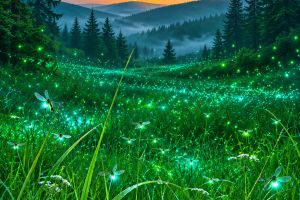
On warm summer evenings, tiny points of light sometimes flicker among grasses, trees, and garden plants. These glowing insects, commonly called fireflies or lightning bugs, produce their own light through a remarkable biological process. Their flashes may appear magical, but every glow begins with chemistry inside a specialized part of the body.
Firefly light is more than a beautiful nighttime display. Many species use carefully timed flashes to find mates, while glowing larvae can signal danger to predators. Scientists have also adapted the chemistry behind this natural illumination for laboratory research. Understanding these different roles reveals why fireflies are so extraordinary.
Inside a Firefly's Light Factory
The secret behind a firefly's glow lies in specialized light-producing organs, usually located near the end of the abdomen.
These organs contain cells capable of producing light through a chemical process called bioluminescence.
Several ingredients are essential to the reaction.
Luciferin is the light-producing molecule, while luciferase is the enzyme that helps the reaction proceed.
Adenosine triphosphate, or ATP, provides chemical energy, and oxygen is also required.
When these substances interact, a series of chemical reactions produces an excited molecule that releases energy as visible light when it returns to a lower-energy state.
The resulting glow is remarkably efficient compared with traditional incandescent lighting.
Very little of the reaction's energy is released as heat, which is why firefly bioluminescence is often described as cold light.
Most familiar flashing fireflies produce yellow-green light, although colors vary among species.
How Fireflies Switch Their Lights On and Off
Fireflies do not simply glow continuously throughout the night.
Many species produce brief flashes separated by carefully controlled intervals.
Scientists have linked this ability to the regulation of oxygen availability within the light-producing organs.
Fireflies breathe through small openings called spiracles, which connect to a network of internal air tubes known as tracheae.
Oxygen reaches the light-producing cells through this respiratory system.
Research indicates that nitric oxide and other cellular processes help regulate how much oxygen is available for the light-producing reaction.
However, the precise control mechanisms are complex and may differ among species.
When conditions within the light gland support the chemical reaction, light appears.
As the reaction is reduced or interrupted, the glow fades.
Some species produce repeated flashes, while others glow more continuously.
This variety makes firefly light patterns an important part of their biology.
Why Flashing Patterns Matter
For many grown fireflies, light is primarily a means of communication during courtship.
In numerous species of flashing males, males fly above vegetation and produce characteristic sequences of light while searching for potential mates.
Females often remain on leaves or grasses, responding with flashes of their own.
The timing of these responses can be crucial.
Different species may use distinct combinations of flash duration, intervals, and repetition rates.
These patterns help individuals identify suitable partners, particularly in places where several firefly species live together.
In some species, the exchange resembles a carefully timed conversation.
A male flashes, a receptive female responds after a characteristic delay, and the male moves toward her position.
Not every firefly relies on this system.
Some species communicate primarily through chemical signals, and certain adults produce little or no visible light.
The familiar flashing courtship display is therefore widespread but not universal.
When Light Becomes a Warning
Firefly light is not limited to attracting mates.
Many firefly larvae glow, even in species whose adults do not produce conspicuous flashes.
These immature insects often live in soil, leaf litter, or other moist environments.
Their glow is generally thought to serve an important defensive function.
Some fireflies contain chemicals that make them distasteful or toxic to particular predators.
In several species, these defensive substances include compounds known as lucibufagins.
A visible glow may act as a warning signal, helping predators learn to avoid insects associated with unpleasant experiences.
This defensive explanation is supported by research, although the function of larval light has not been established equally well for every species.
Interestingly, grown fireflies can also use light in less cooperative ways.
Females of certain Photuris species imitate the courtship responses of other fireflies, attracting males that they subsequently capture and eat.
Firefly communication can therefore involve attraction, protection, and even deception.
Why Scientists Study Firefly Light
The chemistry of firefly bioluminescence has become an important tool in biological research.
Firefly luciferase produces measurable light when the appropriate chemical ingredients are available.
Scientists can use this reaction to detect ATP, monitor cellular activity, and investigate how genes are expressed.
In certain laboratory experiments, researchers attach the genetic instructions for luciferase to biological systems they want to study.
The amount of light produced can then provide information about the activity of those systems.
Luciferase-based methods are used in fields ranging from molecular biology to medical research.
The reaction's high light-producing efficiency has also encouraged interest in bio-inspired technologies.
However, a glowing insect and a practical household lamp operate under very different conditions.
Maintaining a biological light-producing reaction requires suitable chemicals and a controlled environment.
Fireflies are therefore especially valuable as models for scientific measurement rather than ready-made replacements for conventional lighting.
Protecting the Nighttime Display
Fireflies depend on more than the chemical reactions inside their bodies.
Their survival also requires suitable habitats, food sources and conditions for reproduction.
Many species spend much of their lives as larvae in moist soil, vegetation or leaf litter.
Habitat destruction, pesticide exposure and changes in local moisture conditions can threaten these environments.
Artificial light at night presents another concern.
For species that depend on visible courtship signals, bright outdoor lighting can interfere with their ability to find mates.
The effects vary among species and depend on the intensity, color, and timing of the illumination.
People can support firefly-friendly habitats by reducing unnecessary nighttime lighting, limiting pesticide use and preserving suitable vegetation.
Leaving some leaf litter and undisturbed ground can also benefit species that develop in these environments.
Conservation matters because fireflies are not merely decorative insects.
Their light signals are part of complex ecological relationships that have evolved over millions of years.
Fireflies transform chemical energy into light with extraordinary efficiency, using specialized organs to create flashes that carry meaningful signals. Their glow can help adults find mates, warn predators, and, in some species, even deceive other insects.
The same chemistry has given scientists valuable tools for studying living cells.
Yet these remarkable displays depend on healthy habitats and naturally dark nights. Protecting those conditions helps preserve one of nature's most fascinating forms of communication, where a brief flash can tell an entire story.